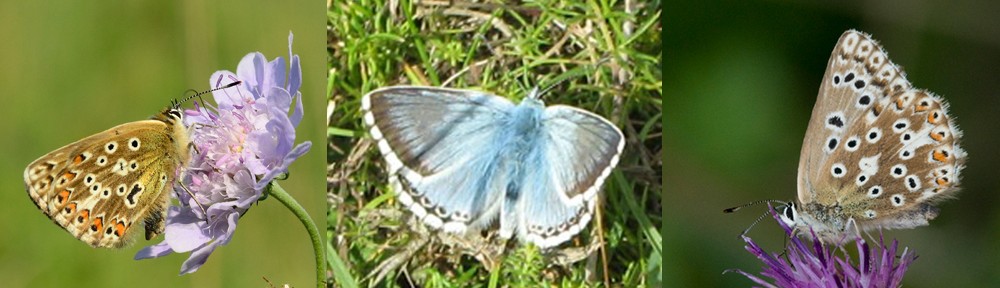
The 2025 season was our 19th year of butterfly monitoring on the two sites. Following generally poor weather in 2024, the 2025 season was much warmer but very dry. Transect walks were completed in each of the 26 weeks on the Roman Road and in 25 of the 26 weeks on Fleam Dyke.
Totals of 23 species were recorded on Fleam Dyke and 24 species on the Roman Road. Total butterfly sightings showed marginal increases compared with 2024 on both sites but there were large variations between species. Some species including the Large and Small Whites, Orange-tip, Gatekeeper, Small Heath and the Marbled White did quite well while others including the Small Tortoiseshell, Ringlet, Brown Argus and Speckled Wood gave poor results.
Looking at the data for individual species in more detail, the first of our habitat-specialist species, the Chalkhill Blue, which in 2024 on Fleam Dyke had its worst year since 2012 showed an encouraging increase of 38%, compared with 2024. On the Roman Road, however, the very small population of this species was still surviving in 2024 but none were recorded in 2025. Neither the Adonis Blue nor the Small Blue, were recorded this year. These two species had been seen in very small numbers in recent years, the first on Fleam Dyke and the second on the Roman Road.
Another habitat-specialist, the Green Hairstreak, had an average year on Fleam Dyke with a small increase in number compared with 2024. One was recorded on the Roman Road. For the fourth successive year, no Dark Green Fritillaries were recorded on either site.
Moving on to the wider countryside species, Small/Essex Skippers were down in number compared with last year. The Large Skipper, which occurs in small numbers on both sites, was down in number on Fleam Dyke but showed a modest increase on the Roman Road.
There were less Brimstones compared with 2023 and 2024, but the indices* were still around average on both sites. Although Green-veined White numbers were down, the Large and Small Whites showed significant increases. The Orange-tip also showed increases compared with 2024. No Clouded Yellows were recorded this year.
Brown Argus numbers remained very low after an excellent season in 2023. Common Blue numbers were higher than in 2024,while on Fleam Dyke, there were less Holly Blues. However, there was a substantial increase in the number of this species on the Roman Road. In 2024, no Small Coppers were seen on either site but this year, we recorded a small number on each site.
It was another mixed year for the vanessids. The Red Admiral does show large differences from year to year but in 2025, numbers were around average. However, they were down in comparison with 2024. For the third successive year, the Small Tortoiseshell had a very poor season. Peacock numbers were slightly down compared with 2024 but they were still around average. No Commas were recorded on Fleam Dyke this year and although numbers are never very high they remained above average on the Roman Road with 14 sightings. Numbers of the Painted Lady, a migrant species, were again very low with just 5 recorded on each site.
There were less Marbled Whites on Fleam Dyke than in 2024 but on the Roman Road, numbers were the highest since 2020. The Marbled White can still be regarded as one of our success stories because until 2018, it was recorded in very low numbers with indices in single figures on both sites. The increase reflects a general trend in the area. The Speckled Wood had a very poor season. None were recorded on Fleam Dyke but there was an increase from the very low number recorded in 2024 on the Roman Road. The Gatekeeper had an excellent year on Fleam Dyke with the highest number recorded to date, slightly higher than the previous best year of 2023. On the Roman Road, numbers were very close to those recorded in 2024. The Meadow Brown had a good year, with around average numbers on Fleam Dyke and above average numbers on the Roman Road. The gradual decline in Ringlet numbers, over a number of seasons, to indices of only 1 and 4 respectively on Fleam Dyke and the Roman Road in 2023, was reversed in 2024, with indices increasing to 28 and 9 but numbers have declined again this year to 6 and 2 respectively. The Small Heath had its best year to date on the Roman Road and after a decline in 2024, showed an increase on Fleam Dyke to a number around the average.
* The index is a measure of abundance, which is calculated for each species. It is the total number of butterflies recorded in the transect counts, adjusted, where necessary, using estimated numbers for any missing counts or where weather conditions were not within the guidelines. With only one late-season transect walk missed in 2025, and counts done in good weather, the index and total number recorded are essentially the same.
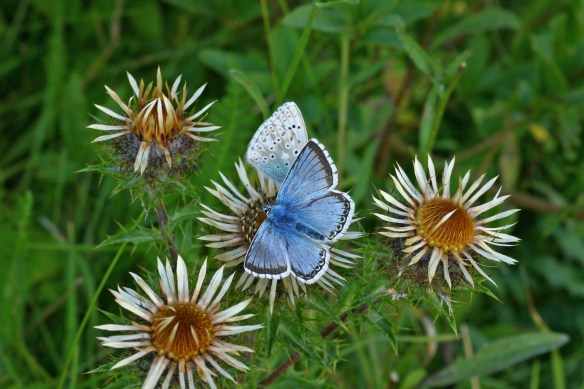
Chalkhill blues on carline thistle, Fleam Dyke
 Friends of the Roman Road and Fleam Dyke